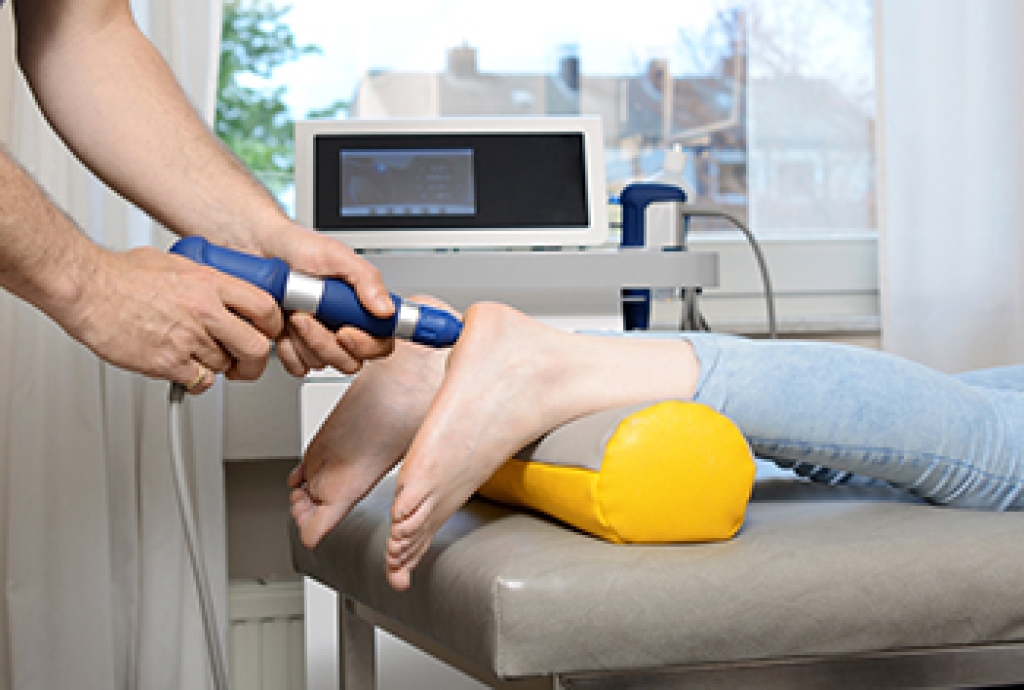
What Is Extracorporeal Shock Wave Therapy (ESWT)?

In Extracorporeal Shock Wave Therapy (ESWT), a handheld device sends a series of acoustic pulses through the surface of the skin to an area of damaged tissue. This intense energy creates a microtrauma in the injured tissue, causing the body to respond by increasing blood circulation and metabolism. This accelerates the body’s natural healing response, helps the body to produce new cells, and reduces pain. Shockwave therapy is a non-invasive treatment with minimal side effects. The treatments only take a couple of minutes and are usually administered once a week for 3-4 weeks or more, depending on the level of damage/pain and how long it has been present. Shockwave therapy can be very effective in the treatment of plantar fasciitis, Achilles tendinopathy, and more. Contact your podiatrist to see if your condition may be treated with ESWT.

Shockwave therapy is a treatment commonly used to treat various injuries and conditions, particularly plantar fasciitis in the feet. To learn more, consult with our podiatrists from Superior Foot & Ankle Center. Our doctors can provide the care you need to keep you pain-free and on your feet.

Shockwave Therapy

Shockwave therapy is a new treatment option designed to treat bone conditions such as tennis elbow, shoulder pain, and others. Shockwave therapy uses high intensity sound waves that are directed to the affected tissues of the body with pinpoint accuracy. The effects are very beneficial, leading to a production of collagen fibers, eliminating inflammation.

Who Benefits from Shockwave?

Shockwave is recommended for patients suffering from heel pain and associated problems. Heel pain is a common condition which can be caused by obesity, overexertion, and spending a substantial amount of time on hard floors with your feet exposed and unsupported.

Fast and Easy

The therapy is actually a simple process that can leave patients feeling better the very next day. Shockwave therapy is not as dramatic as it sounds. It enables more blood flow to effected areas, addressing the source of the problem and allowing treatment to last for a long time.

Treatment & Recovery Time

Shockwave treatment will enable your feet to recover quickly. This is especially important since surgery is not required. It is cost effective and does not require the use of anesthesia. This treatment is a better option to surgery, since it is proven safe.

If you have any questions, please feel free to contact our office located in Long Beach, CA . We offer the newest diagnostic and treatment technologies for all your foot care needs.


Read more about Shockwave Therapy

Do I Need Surgery for a Broken Ankle?

A broken ankle may require surgery if the ankle is unstable and the bone that is broken is displaced. During the procedure, the surgeon realigns the affected bones and fixes them in the proper position using a fixation device, such as a screw, steel pins, or stabilizing rods. Recovery from this surgery can take up to 12 weeks and requires wearing a cast or boot. While not everyone is a good candidate for surgery, leaving a fractured ankle untreated can lead to ankle arthritis and pain. If you have broken your ankle, please consult with a podiatrist to find the right treatment for you. 

Broken ankles need immediate treatment. If you are seeking treatment, contact our podiatrists from Superior Foot & Ankle Center. Our doctors can provide the care you need to keep you pain-free and on your feet. 

Broken Ankles
A broken ankle is experienced when a person fractures their tibia or fibula in the lower leg and ankle area. Both of these bones are attached at the bottom of the leg and combine to form what we know to be our ankle.

When a physician is referring to a break of the ankle, he or she is usually referring to a break in the area where the tibia and fibula are joined to create our ankle joint. Ankles are more prone to fractures because the ankle is an area that suffers a lot of pressure and stress. There are some obvious signs when a person experiences a fractured ankle, and the following symptoms may be present.

Symptoms of a Fractured Ankle

  • Excessive pain when the area is touched or when any pressure is placed on the ankle
  • Swelling around the area
  • Bruising of the area
  • Area appears to be deformed

If you suspect an ankle fracture, it is recommended to seek treatment as soon as possible. The sooner you have your podiatrist diagnose the fracture, the quicker you’ll be on the way towards recovery.

If you have any questions, please feel free to contact our office located in Long Beach, CA . We offer the newest diagnostic and treatment technologies for all your foot care needs.

Read more about All About Broken Ankle

Tips for Dealing With Hammertoes

Hammertoes typically occur in the smaller toes of the foot. They can also be referred to  as “Mallet Toe” or “Claw Toe,” depending on how the foot is affected. These conditions often occur when the soft tissues of the foot become too tight or get injured. Tight shoes are the most common cause of hammertoe, and of the variations  can be the easiest to fix by wearing open-toed shoes and sandals, or roomy, softer closed-toe shoes. Shoe inserts, wrapping the toes after exercise, and maintaining a healthy body weight can help prevent excess pressure on the feet and toes. If discomfort persists, see a podiatrist who can recommend exercises and offer other solutions.

Hammertoes can be a painful condition to live with. For more information, contact our podiatrists of Superior Foot & Ankle Center. Our doctors will answer any of your foot- and ankle-related questions.

Hammertoe

Hammertoe is a foot deformity that occurs due to an imbalance in the muscles, tendons, or ligaments that normally hold the toe straight. It can be caused by the type of shoes you wear, your foot structure, trauma, and certain disease processes.

Symptoms

  • Painful and/or difficult toe movement
  • Swelling
  • Joint stiffness
  • Calluses/Corns
  • Physical deformity

Risk Factors

  • Age – The risk of hammertoe increases with age
  • Sex – Women are more likely to have hammertoe compared to men
  • Toe Length – You are more likely to develop hammertoe if your second toe is longer than your big toe
  • Certain Diseases – Arthritis and diabetes may make you more likely to develop hammertoe

Treatment

If you have hammertoe, you should change into a more comfortable shoe that provides enough room for your toes. Exercises such as picking up marbles may strengthen and stretch your toe muscles. Nevertheless, it is important to seek assistance from a podiatrist in order to determine the severity of your hammertoe and see which treatment option will work best for you.

If you have any questions, please feel free to contact our office located in Long Beach, CA . We offer the newest diagnostic and treatment technologies for all your foot care needs.

Read more about What Are Hammertoes?

Preventing Fungal Toenail Infections

Fungal toenail infections are a common problem that can cause your toenails to become yellowed, crumble, thicken and potentially separate from the nail bed. The fungi that usually cause toenail infections often thrive in warm, moist environments. They can enter the nail through tiny cracks and begin to grow underneath it. Thankfully, a few measures can be taken to prevent this from happening. Make sure your feet are always properly dried, your toenails are kept short, and your socks are clean. It is also important to use your own footwear in public pools and showers, and use an antifungal spray for your shoes. If you do get a toenail infection, please consult a podiatrist for treatment. 

If left untreated, toenail fungus may spread to other toenails, skin, or even fingernails. If you suspect you have toenail fungus it is important to seek treatment right away. For more information about treatment, contact our podiatrists of Superior Foot & Ankle Center. Our doctors can provide the care you need to keep you pain-free and on your feet.

Symptoms

  • Warped or oddly shaped nails
  • Yellowish nails
  • Loose/separated nail
  • Buildup of bits and pieces of nail fragments under the nail
  • Brittle, broken, thickened nail

Treatment

If self-care strategies and over-the-counter medications does not help your fungus, your podiatrist may give you a prescription drug instead. Even if you find relief from your toenail fungus symptoms, you may experience a repeat infection in the future.

Prevention

In order to prevent getting toenail fungus in the future, you should always make sure to wash your feet with soap and water. After washing, it is important to dry your feet thoroughly especially in between the toes. When trimming your toenails, be sure to trim straight across instead of in a rounded shape. It is crucial not to cover up discolored nails with nail polish because that will prevent your nail from being able to “breathe”.

In some cases, surgical procedure may be needed to remove the toenail fungus. Consult with your podiatrist about the best treatment options for your case of toenail fungus.  

If you have any questions, please feel free to contact our office located in Long Beach, CA . We offer the newest diagnostic and treatment technologies for all your foot care needs.


Read more about Treating Toenail Fungus

Connect With Us